
What is an Energy Audit?

  • An energy audit is a systematic, technical study of how energy is consumed in a facility,be it an industrial plant, commercial building, hospital, campus, or utility network. It tracks how energy enters the system (electricity, fuel, steam, compressed air), how it flows through equipment and processes, and where it is ultimately consumed or wasted.

    Under India’s Energy Conservation Act, 2001 , an energy audit is defined as the verification, monitoring, and analysis of energy use, accompanied by a technical report that provides recommendations for improving energy efficiency, including a cost–benefit analysis and an actionable plan to reduce energy consumption.

Objectives of an Energy Audit

The primary aim of an energy audit is to improve energy performance while ensuring safety, quality, and productivity. Specifically, an energy audit helps to:

  • Quantify energy consumption: Map energy usage by department, process, equipment, and time to establish a clear energy balance.
  • Identify inefficiencies and wastage: Highlight overloaded transformers, inefficient motors, air leaks, poor power factor, oversized pumps/fans, lighting losses, idle running, and other hidden drains.
  • Recommend energy-saving measures: Suggest no-cost or low-cost measures (schedule adjustments, set-point tuning, switching off idle loads) and investment-based solutions (high-efficiency motors, LED lighting, automation, waste heat recovery, harmonic filters).
  • Provide cost–benefit analysis: Each recommendation includes estimated energy savings, monetary savings, required investment, and payback period to help management prioritise projects.
  • Create a long-term roadmap: Establish a baseline for future performance, support energy-efficiency budgeting, and integrate with standards like ISO 50001 and ISO 50002.

Why is an Energy Audit Required?

Energy is often one of the top three operating costs in any facility, comparable to labor and raw material. Unlike labor or materials, energy costs can be reduced significantly without affecting output by improving efficiency.

An energy audit is essential because:

  • Rising energy prices and regulatory pressures

    Electricity tariffs, fuel costs, and demand charges continue to rise, while governments push for reduced energy intensity and lower greenhouse gas emissions.

  • Hidden energy losses

    Overheating cables, throttled valves, leaking compressed air, poor power factor, or harmonics rarely trigger alarms but waste significant energy over time.

  • Energy efficiency as the fastest, cheapest power source

    Every unit of energy saved is equivalent to a unit that doesn’t need to be generated or purchased, often cheaper than adding new capacity.

  • Compliance and branding

    Large “designated consumers” in India are required to conduct periodic energy audits. Demonstrating energy efficiency also strengthens ESG (Environment, Social, Governance) performance and corporate reputation.

Who Needs an Energy Audit?

Energy audits are relevant for any organisation with significant energy consumption, including:

  • Industrial plants: Cement, steel, pharma, food, chemicals, textiles, engineering, FMCG, and more,complex processes and high energy intensity make detailed audits highly beneficial.
  • Commercial & institutional buildings: IT parks, malls, offices, hotels, hospitals, universities, data centres, airports, and large campuses. Energy savings potential is highest in HVAC, lighting, and pumps.
  • Utility and infrastructure sectors: Water/wastewater utilities, DISCOMs, district cooling plants, street lighting, metro stations, and railway facilities. Energy audits help reduce losses, optimise operations, and improve reliability.
  • Government & public buildings: Public sector buildings are encouraged or mandated to conduct energy audits to improve performance and reduce expenditure.

When Should You Conduct an Energy Audit?

Energy audits are applicable at various stages of a facility’s lifecycle:

  • Periodic audits (every 2–3 years)

    For large or energy-intensive facilities, detailed audits ensure continuous improvement and identify new saving opportunities.

  • Before major expansions or upgrades

    Pre-project audits help right-size new equipment (transformers, cables, chillers, compressors, pumps, DG sets), avoiding overdesign and energy waste.

  • When energy bills or demand spike

    Audits trace causes of sudden rises in bills, demand, or penalties due to low power factor, demand charges, or high TOD tariffs.

  • When facing power quality or reliability issues

    Nuisance tripping, overheating, flickering lights, motor failures, or breakdowns may be caused by poor power quality, unbalanced loads, or harmonics,issues a combined energy and power quality audit can detect.

  • When pursuing certifications or sustainability goals

    Organisations working towards ISO 50001, green building ratings, ESG targets, or internal sustainability goals use audits as a baseline for decarbonisation and energy management roadmaps.

Benefits of an Energy Audit

A professionally executed energy audit delivers financial, operational, and environmental benefits:

  • Direct cost savings

    Reduce electricity/fuel consumption, kVA demand, and improve power factor, often recovering audit and investment costs within months.

  • Improved reliability and asset life

    Efficient systems run cooler, reducing wear on transformers, motors, cables, and other equipment.

  • Enhanced process performance and comfort

    Optimised HVAC, lighting, and pumping improve production stability, product quality, and building comfort.

  • Reduced maintenance and downtime:

    Correcting energy issues reduces breakdowns, trips, and maintenance costs.

  • Environmental benefits & compliance

    Energy savings lower greenhouse gas emissions and help meet national energy efficiency goals.

  • Strong business case for future investments

    Provides concrete numbers, baseline, savings potential, investments, and payback, making it easier to justify energy efficiency projects to management and investors.

Standards and Guidelines Followed

Our energy audits comply with national and international standards to ensure credibility and comparability:

  • Energy Conservation Act, 2001 (India)

    Defines energy audit and empowers BEE to frame rules and guidelines.

  • BEE Guidelines & State Nodal Agency Guidelines

    Methodology for preliminary and detailed audits with sector-specific checklists and reporting formats.

  • ISO 50002-1:2025

    International standard defining principles, roles, process requirements, and deliverables for energy audits.

  • ISO 50002-2 / 50002-3

    Detailed guidance for building and process industry audits.

  • ISO 50001

    Energy Management System for continuous performance improvement.

  • Relevant equipment & safety standards

    IEC/IS standards, ASHRAE guidelines, OEM datasheets, and safety norms are referenced to ensure technically sound recommendations.

Our Energy Audit Procedure

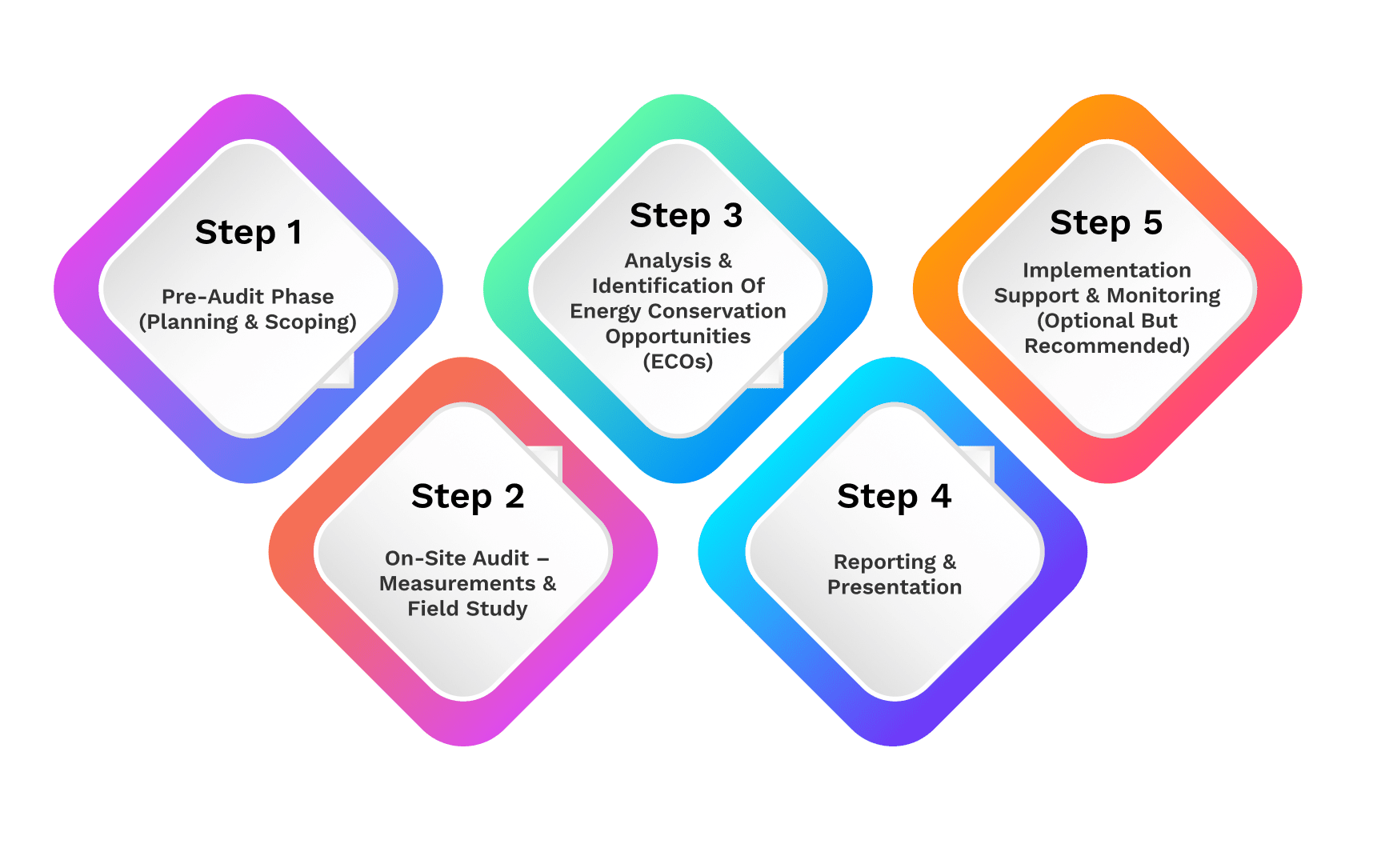
We follow a structured, multi-stage process aligned with BEE methodology and ISO 50002 standards:

  • Kick-off meeting with client to understand facility, operations, pain points, and expectations.
  • Define audit scope: entire facility or specific systems; preliminary or detailed audit.
  • Collect data: Single-line diagrams, equipment lists, utility bills, operating schedules, production data, maintenance history, and past studies.

  • Walk-through survey

    Visual inspection of transformers, switchgear, motors, drives, lighting, HVAC, compressors, boilers, steam systems, process equipment, and building envelope.

  • Instrumentation & measurements

    Voltage, current, power factor, harmonics, motor load, compressor performance, boiler efficiency, HVAC performance, lighting levels, and more under normal, peak, and part-load conditions.

  • Staff interviews

    Gather insights on real operating practices, constraints, and historical issues.

  • Validate data and develop energy balance across major systems.
  • Benchmark performance indicators against best practices and design standards. Identify ECOs/ECMs for load management, power factor improvement, motor resising, HVAC optimisation, lighting retrofits, waste heat recovery, and more.
  • Estimate potential energy savings, cost savings, required investment, and simple payback for each measure.

Deliver a comprehensive technical report including:

  • Executive summary with key findings
  • Facility description and baseline energy analysis
  • Measurement results and observations
  • System-wise energy-saving opportunities
  • Financial analysis and implementation priorities
  • Roadmap and timeline for implementation
  • Presentation to management for discussion, clarifications and final action plan.

  • Support in vendor selection, technical specification, and implementation of recommended measures.
  • Post-implementation verification to confirm actual savings.
  • Continuous energy management through periodic mini-audits and dashboards, especially for ISO 50001-adopting organisations.