RUL (Remaining Useful Life) Study of Transformer, Motor & Cable

Remaining Useful Life (RUL) is the scientifically estimated time an electrical asset,such as a transformer, motor, or cable,can continue to operate safely and reliably before the risk of failure becomes unacceptable.

What Is a RUL Study?

A Remaining Useful Life (RUL) Study scientifically determines how long your electrical assets can continue to operate safely, reliably, and economically.

It combines:

  • Advanced field diagnostics
  • Condition monitoring data
  • Degradation & aging models
  • Standards-based thresholds and Health Index (HI) scoring

We apply this methodology to three critical asset classes:

  • Power Transformers

    Focus on insulation system health (paper–oil), windings, core, bushings, tap-changers. We track moisture, dissolved gases, dielectric losses, hot spots, and mechanical integrity.

  • Induction/Asynchronous Motors

    Focus on stator insulation, rotor bars, bearings, alignment, cooling, and power quality. We capture insulation indices, surge tests, vibration spectra, and thermal performance.

  • Power Cables (MV/LV)

    Focus on dielectric condition, water-treeing, semicon interfaces, joints/terminations, and sheath integrity using VLF–Tan δ–PD, IR/PI, and thermography.

Why Is It Done?

To understand the exact condition of critical equipment and prevent unexpected failures.

RUL Study helps identify:

  • Hidden defects (PD, moisture, bearing wear, water-treeing, etc.)
  • Rate of insulation and mechanical degradation
  • Key risk contributors (thermal, electrical, mechanical, environmental)
  • How long the asset can run safely
  • What needs to be repaired, restored, or replaced

Objectives of the Study

  • Quantify Current Health

    Establish the present technical condition via measurable indices (IR, PI, Tan δ, PD, DGA, vibration, thermography, etc.).

  • Estimate Remaining Life

    Use trends, aging models, and standards thresholds to forecast time-to-failure (technical or economic).

  • Identify Dominant Degradation Mechanisms

    Thermal aging, moisture ingress, oxidation, mechanical loosening, harmonic stress, contamination, bearing wear, water-treeing, etc.

  • Enable Condition-Based Maintenance (CBM)

    Replace periodic maintenance with data-driven interventions.

  • Reduce Unplanned Outages & Safety Risks

    Prioritise repairs/replacements before failure to protect personnel and equipment.

  • Optimise CAPEX/OPEX

    Stage investments by risk criticality; extend life where feasible; avoid premature replacement.

Why This Study Is Required

  • Aging & Thermal Stress

    Insulation weakens rapidly with heat; even a 6–8°C rise can cut insulation life nearly in half.

  • Electrical Stress

    Overvoltage events, switching surges, harmonics, and partial discharge accelerate dielectric breakdown.

  • Mechanical & Environmental Factors

    Vibration, misalignment, dust, moisture, and corrosive surroundings contribute to faster deterioration.

  • Operational Patterns

    Frequent starts, overloads, unbalanced loads, and poor power quality increase thermal and mechanical strain.

  • Hidden Defects

    Issues like incipient PD, loose connections, early-stage bearing wear, and water-treeing often remain undetectable without specialised diagnostics.

  • Compliance & Insurance Needs

    Audits and insurers increasingly demand documented condition assessments for safety and reliability.

Benefits

  • Failure Prevention

    Early detection of PD, moisture, loose windings, bearing faults, water-treeing.

  • Extended Life

    Implement drying, reconditioning, re-insulation, bearing replacement, sealing, or PQ corrections.

  • Higher Reliability & Safety

    Lower arc-flash risk, fewer emergency outages, better contingency planning.

  • Energy & PQ Savings

    Reduce losses, penalties, and nuisance tripping by correcting harmonics/unbalance/loose contacts.

  • Budget Clarity

    Risk-ranked CAPEX roadmap; defer non-critical replacements; negotiate warranties/insurance with evidence.

  • Compliance Evidence

    Standards-aligned results for regulators, corporate audits, and insurers.

Standards Followed -Practical Matrix (Indicative)

  • Transformers

    IEC 60076, IEC 60422, IEEE C57.104, IEEE C57.152, IS 2026, IS 1866 Type & routine tests, condition assessment, oil maintenance, DGA limits & trending

  • Motors

    IEC 60034, IEEE 112, IEEE 43, ISO 10816/20816, IS 12615 Performance, insulation testing, vibration severity, acceptance criteria

  • Cables

    IEEE 400/400.2/400.3, IEC 60502-2, IEC 60270, IEC 60885-3, IS 7098 Field diagnostics, acceptance & maintenance tests, PD, Tan δ

  • PQ & Thermography

    IEC 61000, IEEE 519, ISO 18434, IEC 62446 PQ limits, THD guidance, thermal inspections

  • Safety & Work Practices

    IS 5216, IS 3043, NFPA 70E, site safety codes Safe isolation, earthing, PPE, LOTO

  • Application Note

    Latest editions applied; acceptance bands aligned to OEM data, asset class, and criticality.

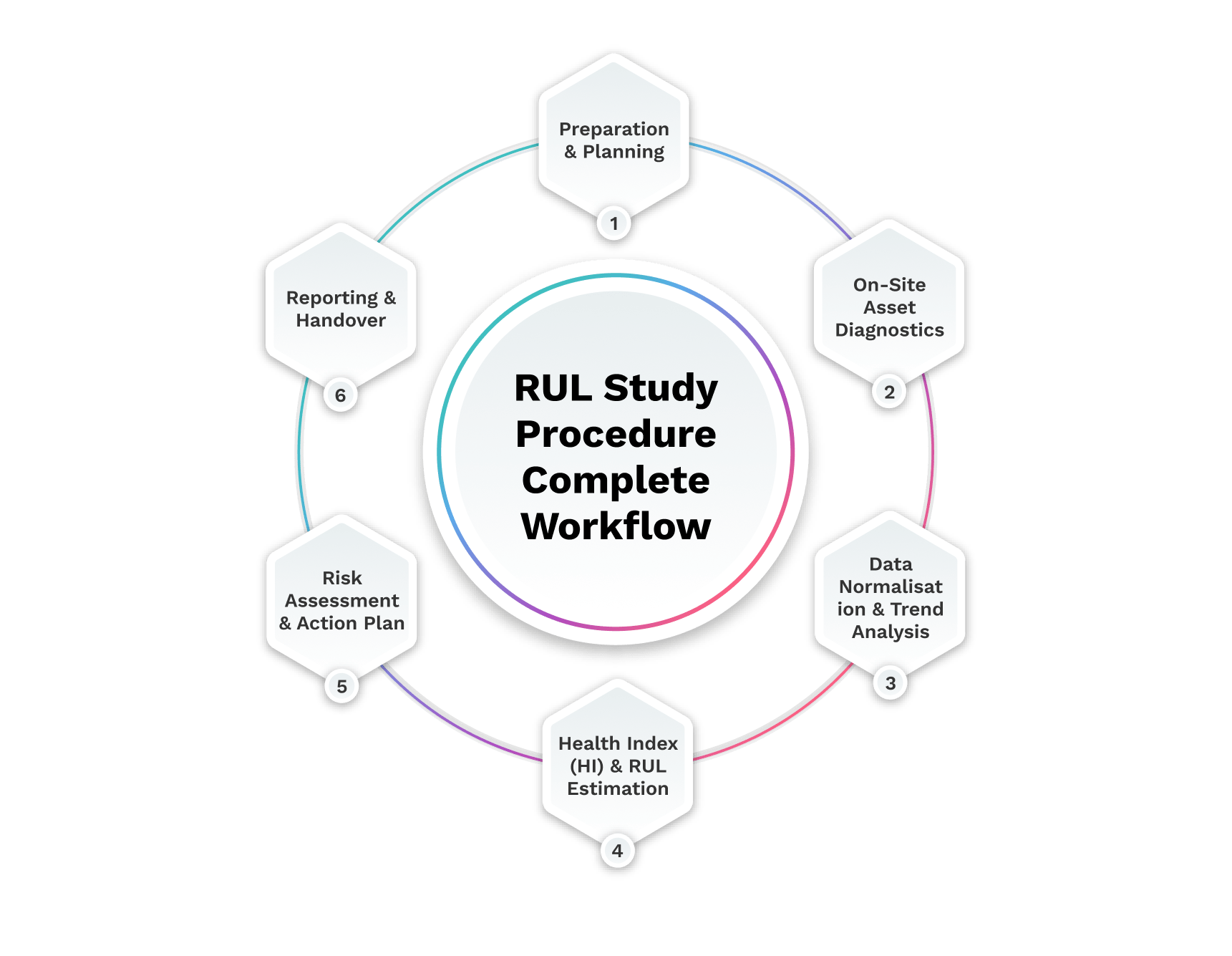
RUL Study Procedure Complete Workflow

  • Gather asset information: nameplate details, single-line diagrams (SLDs), historical test/maintenance records, alarms/trips, and PQ data.
  • Define the testing schedule, including shutdown windows if required, safety protocols (LOTO, permits), and measurement points.
  • Rank assets by criticality and select the appropriate diagnostic test package for each asset.

  • A. Transformer Diagnostics

    • Insulation Resistance (IR) & Polarisation Index (PI): Establish baseline insulation condition.
    • Tan δ / Power Factor: Assess dielectric losses, moisture, and contamination in windings & bushings.
    • Dissolved Gas Analysis (DGA): Detect thermal and electrical fault signatures (H₂, CH₄, C₂H₂, C₂H₄, C₂H₆, CO, CO₂).
    • Oil Quality Tests: Measure acidity (TAN), interfacial tension, moisture content (ppm), breakdown voltage (BDV), and inhibitor levels.
    • Winding Resistance & Tap Transformer Ratio (TTR): Identify turn shorts, contact resistance, and tap-changer condition.
    • Sweep Frequency Response Analysis (SFRA): Check mechanical integrity of windings and core post-fault or transport.
    • Thermography: Detect hot connections and cooling anomalies.
    • Power Quality Snapshot: Assess incoming THD and load unbalance as stress multipliers.
  • B. Motor Diagnostics

    • IR/PI & Tan δ: Evaluate stator insulation health.
    • Surge Comparison Test (Offline): Identify turn-to-turn weaknesses.
    • Winding Resistance & Inductance: Check phase symmetry and imbalance.
    • Vibration Analysis (ISO 10816/20816): Monitor bearings, misalignment, looseness, or soft-foot conditions.
    • Motor Current Signature Analysis (MCSA, Online): Detect rotor bar faults and eccentricity.
    • Thermography & Airflow Checks: Identify hotspots and cooling path issues.
    • Power Quality & Start/Load Profile: Evaluate inrush currents, starting time versus thermal limits, voltage dips, and THD.
  • C. Cable Diagnostics

    • IR/PI: Establish insulation baseline.
    • VLF + Tan δ: Assess dielectric losses and water-treeing.
    • Partial Discharge Testing (Online/Offline): Locate and evaluate severity at joints/terminations.
    • Sheath Integrity & Continuity: Detect faults and corrosion risk.
    • Route Thermography / Spot Temperature: Identify localised heating or load anomalies.

  • Adjust readings for temperature and load variations.
  • Compare against historical records and OEM baselines.
  • Map results to health scoring bands (green/amber/red) according to standard limits.

  • Assign weightage to each test based on criticality (e.g., DGA & Tan δ for transformers, PD & Tan δ for cables, vibration & surge for motors).
  • Calculate a composite Health Index (HI%) using asset-specific formulas.
  • Apply aging and probabilistic models (Arrhenius, Weibull) with duty cycle, ambient, and THD factors to estimate RUL.

  • Develop a Likelihood × Impact matrix covering safety, downtime, and replacement lead time.
  • Define corrective actions by timeline:

    Immediate: Address severe PD/gas issues, dangerous vibration, and safety-critical defects.

    Short Term (0–3 months): Dry-out, oil reclaim, bearing replacements, joint re-termination, PQ corrections..

    Medium Term (3–12 months): Refurbishment, rewinding, or cable section replacement.

    Plan Replacement: Budgeted replacement schedule with specifications.

  • Deliver executive summary, detailed asset-wise reports, test certificates, HI & RUL charts, risk tables, photos, and thermograms.
  • Conduct review meetings with operations/management for discussion, Q&A, and roadmap finalisation.